
Sudden cardiac arrest can happen to anyone — including children
Sudden cardiac arrest (SCA) doesn’t discriminate by age. While it’s easy to assume it’s a condition that only affects older Australians, the reality is that it can strike students, teachers and parents without any warning. Approximately 3,000 young Australians are affected by sudden cardiac death each year, and cardiac events on school grounds are not as rare as many people think.
Every minute that passes without defibrillation reduces the chance of survival by 7 to 10 per cent. With the nearest ambulance rarely able to arrive in under five minutes, having an AED on school grounds is not a luxury — it is a genuine lifesaving measure. Early defibrillation can increase the chance of survival to over 70 per cent when used within the first three to five minutes of collapse.
We’ve put together a detailed breakdown of the case for school AEDs in our blog post, 4 Key Reasons Every School Needs an AED on Site.
AED requirements for Australian schools
Australia’s approach to AED legislation is evolving quickly, with South Australia leading the nation. Under the Automated External Defibrillators (Public Access) Act 2022 and its 2024 Regulations, AEDs became mandatory in South Australian state-run primary and secondary schools from 1 January 2025. Private and independent schools must comply from 1 January 2026.
You can read a full breakdown of the requirements, compliance dates and placement rules on our South Australia AED Legislation update.
Outside South Australia, schools across all states and territories still carry obligations under national Work Health and Safety (WHS) legislation to provide a safe environment for staff, students and visitors. Many schools are proactively installing AEDs ahead of any state-level mandates — and the earlier you act, the better prepared your school community will be.
Grants may be available to help with the cost of purchasing an AED. Check our Grants page to see what funding is currently available in your state.
Why schools choose Defibrillators Australia
Free delivery on every order
We offer free freight on every defibrillator and defibrillator bundle, Australia-wide. There are no hidden costs and no minimum order requirements — what you see is what you pay.
Paediatric-capable devices
Children require a different energy level during defibrillation. All of the AEDs we recommend for schools either include built-in paediatric capability or are compatible with paediatric pads, so you are covered for students of all ages.
Expert advice for schools
Not sure which AED is right for your school, or how many devices you need? Our team works with schools across Australia every day. We can help you assess your site, understand your compliance obligations and choose the right solution with confidence.
Ongoing support and maintenance
An AED is only as reliable as its maintenance routine. We supply devices with long battery and pad shelf lives, and our team is available to support you with replacement consumables, questions and guidance whenever you need it.
Where should a school keep its AED?
The guiding principle is accessibility. In an emergency, every second counts, and the Australian Heart Safe School guidelines recommend that an AED should be reachable within 90 seconds of brisk walking from anywhere on school grounds.
For most schools, this means positioning AEDs near high-traffic or high-risk areas, such as the main reception or front office, the gymnasium or sports hall, the oval or playing fields, the staffroom, and any areas where community events are regularly held.
Wall-mounted cabinets with clear AED signage make devices highly visible and easy to locate in a stressful moment. Browse our range of AED cabinets and accessories to complete your setup.
Larger school campuses may require more than one device. If you are unsure how many AEDs your site needs, give our team a call on 1300 331 193 and we can help you work through a placement plan.
Recommended defibrillators for schools
Not all AEDs are the same. For a school environment, you want a device that is simple to use under pressure, suitable for both adults and children, and built to last with minimal maintenance. Here are our top recommendations.
-
Sale!
 FREE SHIPPING
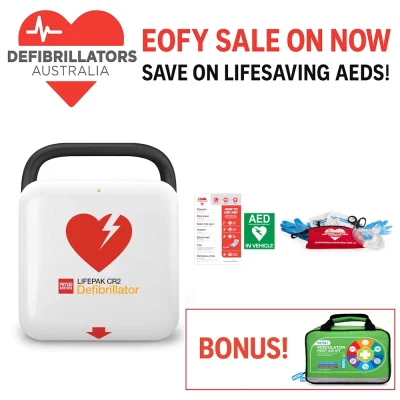
EOFY Sale! LifePAK CR2 Defibrillator
$3,125.00Original price was: $3,125.00.$1,999.00Current price is: $1,999.00. -
Sale!
 FREE SHIPPING
ZOLL AED 3 – Fully Automatic Defibrillator (8531-001202-13)
$3,540.00Original price was: $3,540.00.$2,850.00Current price is: $2,850.00. -
Sale!
 FREE SHIPPING
HeartSine 360P Defibrillator – Fully Automatic
$2,495.00Original price was: $2,495.00.$1,599.00Current price is: $1,599.00.
Frequently asked questions about school defibrillators
Are schools in Australia required to have a defibrillator?
Requirements vary by state. In South Australia, AEDs are now mandatory in all state-run schools from 1 January 2025, with private and independent schools required to comply from 1 January 2026. Other states do not yet have specific AED legislation for schools, but all schools carry obligations under WHS legislation to maintain a safe environment. Many schools across Australia are installing AEDs proactively regardless of their state’s current requirements.
Do you need training to use an AED at a school?
No formal training is required to operate a modern AED. All devices we supply provide clear step-by-step voice and visual instructions that guide the user through every stage of the process. That said, we always recommend that schools encourage staff to complete basic first aid and CPR training. The combination of trained staff and an on-site AED gives your school community the best possible chance of a positive outcome.
Can a school defibrillator be used on a child?
Yes. The AEDs we recommend for schools are either fully paediatric-capable or compatible with paediatric pads. The HeartSine 360P, for example, accepts a paediatric Pad-Pak that automatically adjusts energy levels for younger patients. The ZOLL AED 3 switches to paediatric mode when child pads are attached. We can help you choose the right configuration for your school’s needs.
How many AEDs does a school need?
The general guidance is that an AED should be reachable within 90 seconds of brisk walking from any point on the school grounds. For a compact single-building school, one device positioned centrally may be sufficient. Larger campuses with multiple buildings, ovals and facilities typically require two or more units. Contact our team on 1300 331 193 for a personalised recommendation based on your site layout.
5 Star Customer Service
Our team of Heartsafe Angels are ready to help with any questions you have regarding our AEDs.
Call or email us today 1300 331 193
Make your school heart safe today
A defibrillator on your school grounds is one of the most important investments your school community can make. Our team is here to help you find the right device, understand your obligations and get set up quickly and confidently.
Shop our full range online with free delivery on every order, or call us on 1300 331 193 to speak with a specialist.