
Defibrillators for Aged Care
Protect residents, staff and visitors across your aged care facility or retirement village
Aged care residents face the highest risk of sudden cardiac arrest
Cardiac arrest risk rises significantly with age. The residents of aged care facilities and retirement villages represent the most at-risk population in Australia, with a disproportionately high rate of sudden cardiac events compared to the general community. Australian data shows that aged care facilities account for approximately 8 per cent of all out-of-hospital cardiac arrests, despite housing a small fraction of the total population.
The average ambulance response time across Australian cities is 8 to 11 minutes. In regional areas it can be considerably longer. Without defibrillation, survival chances drop by 7 to 10 per cent for every minute that passes after cardiac arrest. For residents where resuscitation is clinically appropriate and consistent with their wishes, having an AED on site is the single most important factor in improving that outcome.
Every aged care facility and retirement village also hosts visiting families, healthcare professionals and other visitors who may themselves experience a cardiac emergency on your premises. An AED on site protects not just your residents, but everyone who walks through your door.
What the law says for aged care and retirement villages
South Australia is currently Australia’s most advanced state in AED legislation. Under the Automated External Defibrillators (Public Access) Act 2022, aged care facilities and retirement villages are classified as designated buildings. The deadline for non-Crown buildings to comply — including private aged care providers — was 1 January 2026, with penalties of up to $20,000 for non-compliance.
In New South Wales, the Automated External Defibrillators (Public Access) Bill 2024 explicitly lists residential aged care facilities as designated buildings that would be required to install AEDs if the Bill becomes law. Other states are monitoring the SA model closely, and it is widely expected that similar requirements will flow through nationally in the coming years.
Beyond specific AED legislation, aged care providers carry obligations under the Aged Care Quality Standards — particularly Standard 8, which relates to organisational governance and safety. Having a documented emergency response plan that includes AED access and staff awareness is increasingly considered part of meeting these standards. Proactive installation ahead of legislative deadlines demonstrates a genuine duty of care to residents and their families.
Grants may be available to assist with the cost of purchasing AEDs for your facility. Visit our Grants page to find out what funding is currently available in your state.
Why aged care providers choose Defibrillators Australia
Free delivery Australia-wide
Every defibrillator and defibrillator bundle we sell ships free, anywhere in Australia. Whether your facility is in metropolitan Sydney or regional South Australia, there are no freight surprises at checkout.
Devices simple enough for any staff member
Aged care staff come from a range of clinical and non-clinical backgrounds. Every AED we stock is designed to guide the user through each step with clear voice prompts and visual instructions. No medical training is required to use one effectively, which means any staff member present during an emergency can respond with confidence.
Experience with multi-site facilities
We work with aged care organisations managing multiple facilities and campuses. Our team can help you develop a consistent AED programme across all your sites, including device selection, placement recommendations and a maintenance schedule that keeps everything in order.
Replacement consumables and ongoing support
We stock replacement batteries and electrode pads for every device we sell, so you are never left without what you need when consumables expire. Our team is available to answer questions about maintenance, compliance and device performance at any time.
AED placement in aged care environments
Effective AED placement in an aged care facility is about matching device location to resident movement patterns and areas of highest risk. The standard recommendation is that an AED should be reachable within 90 seconds of brisk walking from any part of the facility — but in practice, the goal is to position devices where cardiac events are most likely to occur and where staff are most likely to be present.
Key placement locations include the main dining room and common areas, where residents gather in the largest numbers; the reception and administration area, which is typically staffed at all hours; outdoor areas, gardens and walking paths where residents spend time unsupervised; and any hydrotherapy, physiotherapy or allied health spaces where physical exertion occurs.
For multi-building campuses, a device in each building is strongly recommended. Wall-mounted cabinets with clear AED signage make devices immediately identifiable in an emergency. Browse our range of AED cabinets and accessories to complete your setup, and call our team on 1300 331 193 if you would like help developing a placement plan for your facility.
AEDs and resuscitation planning in aged care
Aged care providers often raise the question of how an on-site AED relates to residents who have advance care plans or do-not-resuscitate (DNR) orders in place. This is an important and reasonable consideration, and one that deserves a clear answer.
Having an AED on site does not override any resident’s documented wishes. An advance care plan or DNR order remains in effect regardless of whether a device is present. Staff should be trained to know which residents have these orders and to follow them accordingly. The AED exists for situations where resuscitation is appropriate and desired — whether for a resident without such a plan, a staff member, a visitor or a family member on the premises.
In short, an AED does not create an ethical conflict — it creates a capability. The decision to use it remains with your staff, guided by each resident’s documented wishes and clinical judgment. Including AED protocols in your emergency response training ensures staff feel confident in both knowing when to act and when to follow an existing care plan.
5 Star Customer Service
Our team of Heartsafe Angels are ready to help with any questions you have regarding our AEDs.
Call or email us today 1300 331 193
Recommended defibrillators for aged care facilities
The best AED for an aged care facility is one that any staff member can operate quickly under pressure, with minimal steps and maximum guidance. Here are our top recommendations for aged care environments.
-
Sale!
 FREE SHIPPING
HeartSine 360P Defibrillator – Fully Automatic
$2,495.00Original price was: $2,495.00.$1,599.00Current price is: $1,599.00. -

LifeVac Genuine – Parents Soft Travel Bag Unit – 4 mask Pack
$134.99 -
Sale!
 FREE SHIPPING
LIFEPAK CR2 Essential – Fully Automatic AED – Defibrillator
$3,095.00Original price was: $3,095.00.$2,199.00Current price is: $2,199.00. -
Sale!
 FREE SHIPPING
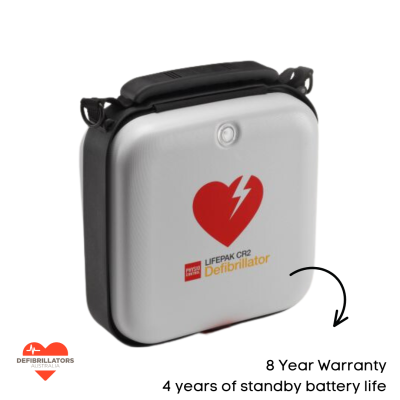
LIFEPAK CR2 Connected – Fully Automatic AED – Wi-Fi Defibrillator
$3,375.00Original price was: $3,375.00.$2,599.00Current price is: $2,599.00.
Frequently asked questions about aged care defibrillators
Are aged care facilities required to have a defibrillator in Australia?
In South Australia, aged care facilities and retirement villages are designated buildings under the Automated External Defibrillators (Public Access) Act 2022. The compliance deadline for private providers was 1 January 2026, with penalties of up to $20,000 for non-compliance. In New South Wales, proposed legislation specifically lists residential aged care facilities as required locations. Other states are expected to introduce similar requirements in coming years. Regardless of your state’s current legislative position, duty of care obligations and quality standards make a strong case for installing an AED proactively.
Can non-clinical aged care staff use an AED?
Yes. AEDs are specifically designed to be used by anyone, regardless of clinical training. Once switched on, the device provides step-by-step voice and visual guidance throughout the entire process. Non-clinical staff — including care workers, administration staff and activity coordinators — can use an AED effectively. We always recommend pairing AED installation with basic CPR awareness training so that all staff feel confident and prepared.
Does having an AED conflict with a resident's advance care plan or DNR order?
No. An AED does not override any resident’s documented wishes. Advance care plans and do-not-resuscitate orders remain in effect regardless of whether an AED is on site. The device is available for situations where resuscitation is appropriate — whether for a resident without such a plan, a staff member, a visitor or a family member. AED protocols should be incorporated into your staff training and emergency response plan so that all team members understand when and how to act.
How many AEDs does an aged care facility need?
This depends on the size and layout of your facility. The standard guidance is that an AED should be reachable within 90 seconds of brisk walking from any point on the premises. For a single-building facility, one or two devices placed in high-traffic areas such as the dining room and reception will typically provide adequate coverage. Multi-building campuses require at least one device per building. Call our team on 1300 331 193 and we will help you develop a placement plan that suits your specific facility layout.
Talk to our team about your facility's needs
Every aged care facility is different, and so is every AED programme. Our team has experience working with aged care providers of all sizes, from single-facility operators to large multi-site organisations. We can help you choose the right devices, plan your placement, understand your compliance obligations and establish a maintenance routine that keeps everything running reliably.
Shop online with free delivery on every order, or call us on 1300 331 193 to speak with a specialist.